
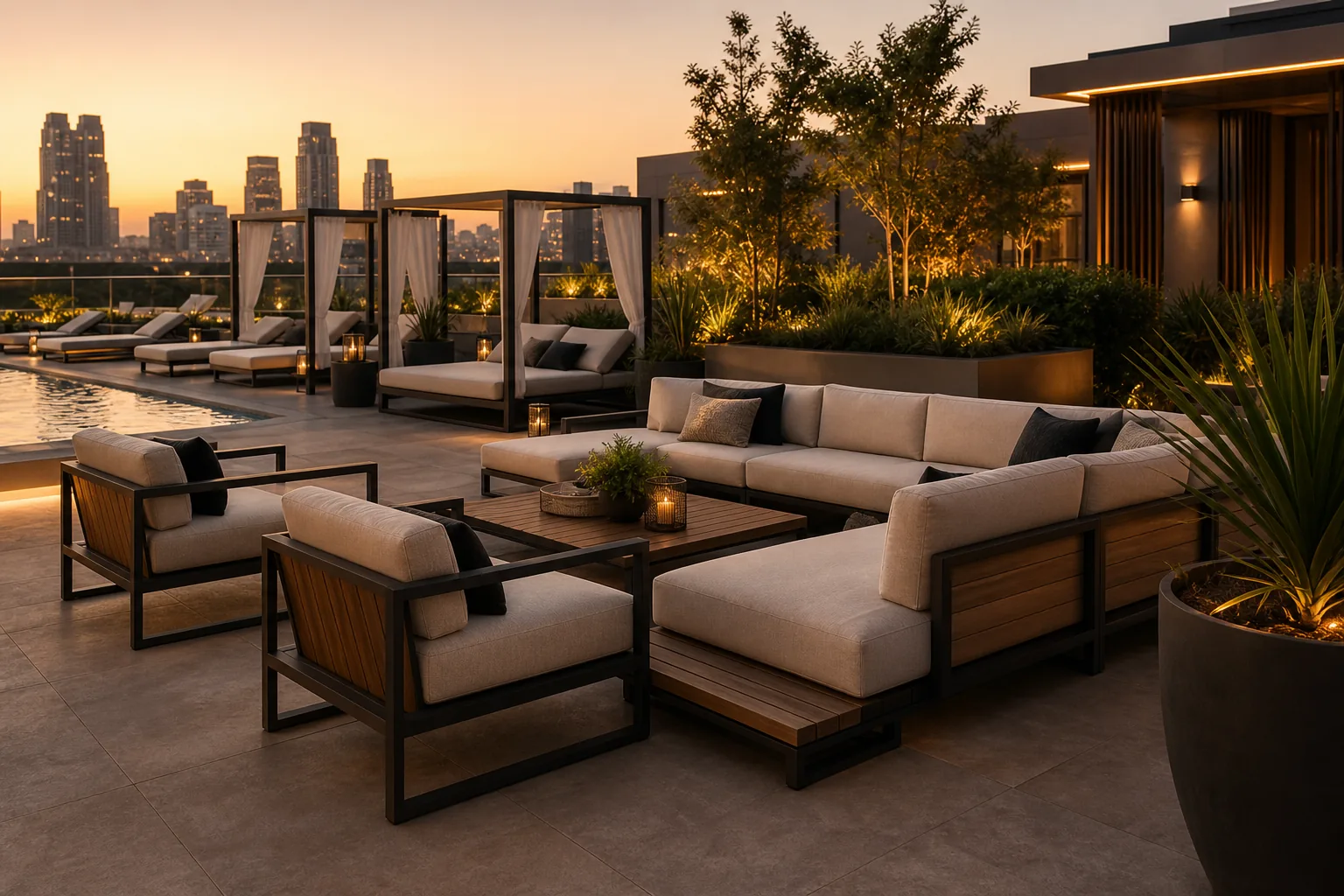
Outdoor Furniture for Apartment Amenities: What Survives a Pool Deck
The amenity deck is where a prospective resident decides whether the rent makes sense. It is the photograph in the listing, the first stop on a tour, and the space that has to look as good in year three as it did the week the property opened. Outdoor furniture for apartment amenities still tends to get bought last, from a patio catalog, in whatever quantity is left in the budget. Then the first summer happens, and the pool deck starts telling on the purchase.
Residential patio furniture is not built for a pool deck
A homeowner's patio set sees one family, a cover in the fall, and a garage in the winter. A pool deck at a 250-unit community sees every resident and every guest they bring, plus sunscreen, chlorine, grill smoke, and nobody putting anything away at the end of the night. The furniture never goes inside. It sits in full sun through the season and stays out through whatever the winter does. That is a commercial duty cycle, and residential product fails it in a predictable order:
- Fasteners first. Plated steel hardware inside an aluminum frame corrodes, and the joint bleeds rust streaks down a chair nobody wants to sit in.
- Cushions second. Printed fabric fades unevenly by the second season, and standard foam holds water long after the rain stops.
- Slings and straps third. They stretch under daily use until the seat sags, and the stitching lets go at the rail.
- Finish fourth. A thin powder coat chalks under UV, so the frame goes flat and dusty even where it has not corroded.
- Weight, whenever the wind decides. Furniture light enough to move easily is light enough to end up in the pool or off the roof.
None of that is a surprise on one chair. It becomes a real problem at amenity-deck quantities, because the failures do not happen at the same rate. Half the loungers fade before the other half, the replacements no longer match, and a deck that was specified as one look ends up reading as three purchases made in three different years.
What we ask before quoting outdoor furniture for apartment amenities
Commercial outdoor product is not really a category. It is a set of decisions, and these are the ones we would rather settle before anything goes into production:
- Frame material and grade, which usually means aluminum for weight and corrosion resistance, in a heavier gauge than a residential equivalent
- Powder coat specification, UV-stable and applied over a properly pretreated frame rather than sprayed onto bare metal
- Fastener metallurgy, because stainless hardware is the difference between a clean joint and a rust stain in year two
- Fabric choice, solution-dyed acrylic where the color goes through the fiber, not printed fabric where it sits on top
- Cushion cores and drainage, including quick-dry foam, mesh bottoms, and frames that let water leave instead of pool
- Wind loading and anchoring, which matters most on rooftop terraces and anywhere the deck funnels a breeze
- Stacking and off-season storage, since somebody on site has to move and store all of it in the fall
- Replacement cushions, slings, and glides, written into the original order instead of chased two seasons later
Count the seats the way residents actually use them
Seat counts get drawn from the site plan and then fail on a Saturday. Loungers face the pool in a single row, so the only shade is against a wall. Dining is specified as one long table when residents arrive in pairs and groups of four. The grill area gets a bench with nowhere to set a plate. We would rather price a deck against how it fills up: loungers at the water, a shaded cluster for people who are not swimming, seating around the grills that works for two people or for six, and enough soft seating in the courtyard that a leasing tour never walks past an empty patch of concrete.
Those counts are also the argument for building rather than buying off a shelf. Daybeds, cabana pieces, and lounge sets produced to a drawing let a courtyard, a rooftop, and a pool deck at the same property share one design language and one finish, in the quantities the property needs at once.
Outside still has to agree with inside
A resident walks from the clubroom to the deck in about ten seconds, which is not long enough to forget what the interior looked like. Frame finishes, fabric tones, and the fixtures overhead all read as one decision or as several. That is the same coordination problem we work through on commercial lighting for multifamily, where exterior and amenity fixtures have to match the common areas they open onto. Settling the finish family once, at the factory, is far easier than matching it later across three suppliers.
Order for the season you plan to open
Outdoor product has a season, and everybody who buys it wants delivery in the same short window. A deck that needs to be photographed in June is not a spring purchase. Custom frames, cushion fabric, and finish all have production time in front of them, and freight does not get faster because a lease-up date moved. Sending us the amenity drawings and a target open date early is worth more than a fast decision made late, and it gives the property the option to phase the deck instead of half-furnishing it.
Buy the amenity deck with the rest of the property
An amenity deck priced on its own is a small order with its own freight, its own lead time, and its own vendor to chase. Priced alongside the interiors headed to the same address, it is one more line on a package that is already moving. When we quote outdoor furnishings built to spec, we would rather see them next to the casegoods, the lighting, the cabinetry, and the fixtures going into the units. That is the whole point of multifamily furniture packages: one order, one finish decision, one freight plan, and one person to call when a date needs to move.
We have managed, developed, and renovated 16,000 units and delivered product in 24 states, and outdoor furniture for apartment amenities goes wrong the same few ways every time: residential product on a commercial deck, seat counts drawn instead of observed, and an order placed after the season already started. Send us your amenity-deck drawings, your seat counts, and your open date. Request a quote or call 317.306.5800, and we will come back with a spec and a factory-direct number.